


Liberia stands at a pivotal moment in its economic history. With iron ore production set to triple, transformative new mineral discoveries, and an ambitious renewable energy agenda, the country offers some of the most compelling investment opportunities in Africa today.
LIMEC 2026 — the Liberia International Mining & Energy Conference — is the premier dedicated gathering for the Liberian extractive and energy sectors, bringing together government ministers, mining executives, energy developers, financiers, technical experts, and service companies to shape the future of this rapidly evolving market.
Held in Monrovia on 28–29 October 2026, LIMEC 2026 is jointly organised by the Ministry of Mines and Energy, Republic of Liberia, the Liberia Chamber of Mines, and AME Trade Ltd. The conference provides an unrivalled platform for deal-making, policy debate, and strategic networking. Whether you are an investor seeking new opportunities, an operator looking to expand, or a service company targeting growth in West Africa, LIMEC 2026 is the essential event for you.

Liberia is home to one of the most resource-rich environments in West Africa. With abundant deposits of iron ore, gold, diamonds, and a newly confirmed suite of critical minerals including lithium, cobalt, manganese, neodymium, and uranium, the country is entering a new era of economic transformation.
Iron ore remains the anchor sector of Liberian mining, with cumulative investment of more than US$3.5 billion representing the largest foreign direct investment in Liberia’s post-war history. A state-of-the-art 20 Mt/year concentrator was inaugurated in June 2025, and shipments are projected to reach 20 Mt in 2026. A new Mineral Development Agreement extends the principal concession to 2050.
Additional iron ore producers are expected to come on stream in 2026, potentially pushing total national output to between 25 and 30 million tonnes per year.
A landmark transnational initiative is developing an iron ore corridor connecting Guinea’s Nimba mountains to Liberia’s Port of Buchanan via a rehabilitated 243-kilometre heavy rail line. Phase 1 construction is scheduled to begin in 2026, creating approximately 2,000 jobs at peak.
Gold output is set to rise with the ramp-up of the Dugbe gold project — spanning approximately 1,410 km² with a resource estimate of 3.3 million ounces. A revised feasibility study is under way with a planned 2026 construction start.
Studies funded by China and concluded in 2025 have confirmed significant deposits of lithium, cobalt, manganese, neodymium, and uranium across Liberia. $3 billion in investment is projected from these discoveries alone, positioning Liberia at the forefront of the battery and technology supply chain.
Diamond mining through alluvial and artisanal methods is widespread, with Kimberley Process Origin Certificates enabling legal export. A landmark $32 million programme from GEF and AfDB is underway to reduce mercury use in artisanal gold mining.
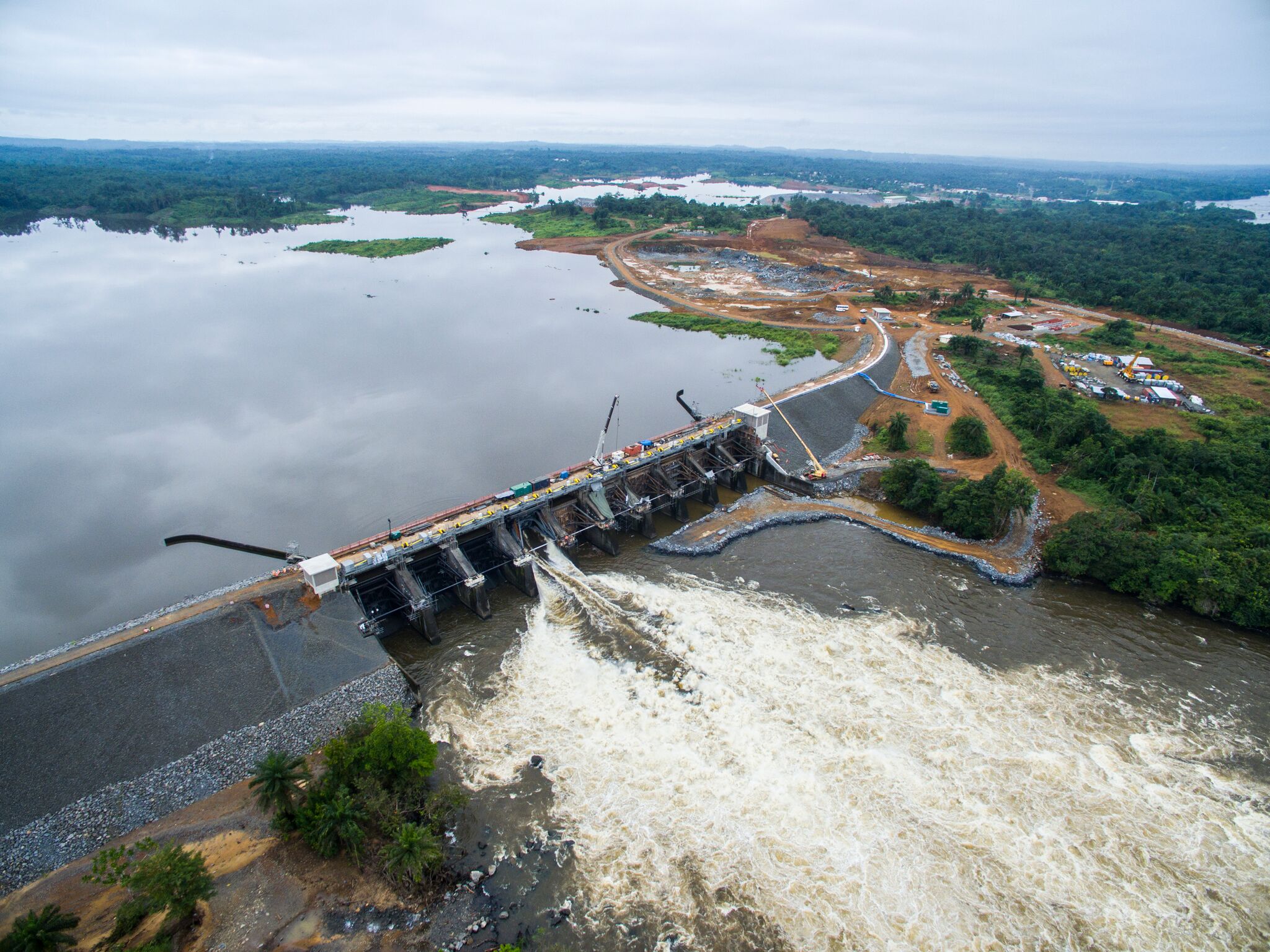
Liberia’s energy sector is undergoing a fundamental transformation. The Government has set an ambitious target of achieving at least 75% renewable energy in the national generation mix, supported by a National Energy Compact and major infrastructure projects.

| Project | Details |
|---|---|
| Mount Coffee HPP | 88 MW of renewable capacity — fully rehabilitated and expanded with US$202 million in MCC support |
| LEEAP | EU-funded initiative (EUR 107 million) connecting 39,792 new customers |
| Transmission Line | 45km double-circuit 66kV line from Paynesville to Roberts International Airport |
| Solar PV + Battery | Hybrid systems installed at 39 health facilities across rural Liberia |
| CLSG Interconnector | Regional power trade link connecting Côte d’Ivoire, Liberia, Sierra Leone, and Guinea |
| Project | Details |
|---|---|
| 20 MW Solar (Mt Coffee) | First phase commissioning planned; first utility-scale solar IPP procurement initiated |
| Saint Paul 2 HPP | Feasibility study underway — tapping the river’s estimated 800 MW total potential |
| LESSAP Phase 2 | World Bank ($33 million): grid expansion, off-grid solar, private mini-grids |
| National Electrification Strategy | Accelerating 172 MW of renewables, total capacity to reach 266 MW |
| Solar IPP Programme | Competitive procurement for independent power producers |
| National Power Master Plan | Comprehensive least-cost plan to be finalised by June 2026 |